Since 1 July, the EU has been rebuilding the rules on small parcels. The €150 duty-free threshold is gone. A €3 interim duty applies per item. A handling fee is coming. Most sellers reacted to those changes because they showed up as money.
This other change landing on 1 November 2026 does not show up as money. It shows up as data. From that date, every parcel a business ships to an EU consumer has to declare, on the customs declaration, which specific product is inside. Not the category. The product. The codes that do this are called product identifiers, or PIDs.
That sounds small. It isn’t. It is the first EU customs rule a seller can fail on without doing anything wrong commercially, because the information it demands often sits with someone else entirely: your manufacturer, your supplier, or the marketplace you list on. And the party legally answerable for the form is usually your carrier or your broker, not you.
In short: From 1 November 2026, B2C parcels entering the EU must declare product identifiers for each item: the M-PID (the shop’s own code, always required), the NS-PID (the maker’s model number, required), and the S-PID (the barcode, only where one exists, with code
Y081filed to say it doesn’t). Until 31 October you can file them against real parcels with a written no-penalty guarantee. After that, enforcement starts.
1. What is an EU product identifier?
An EU product identifier (PID) is a code declared on the customs form that names the exact product inside a parcel, rather than its category. From 1 November 2026, PIDs must be declared for every item in a B2C parcel entering the EU.
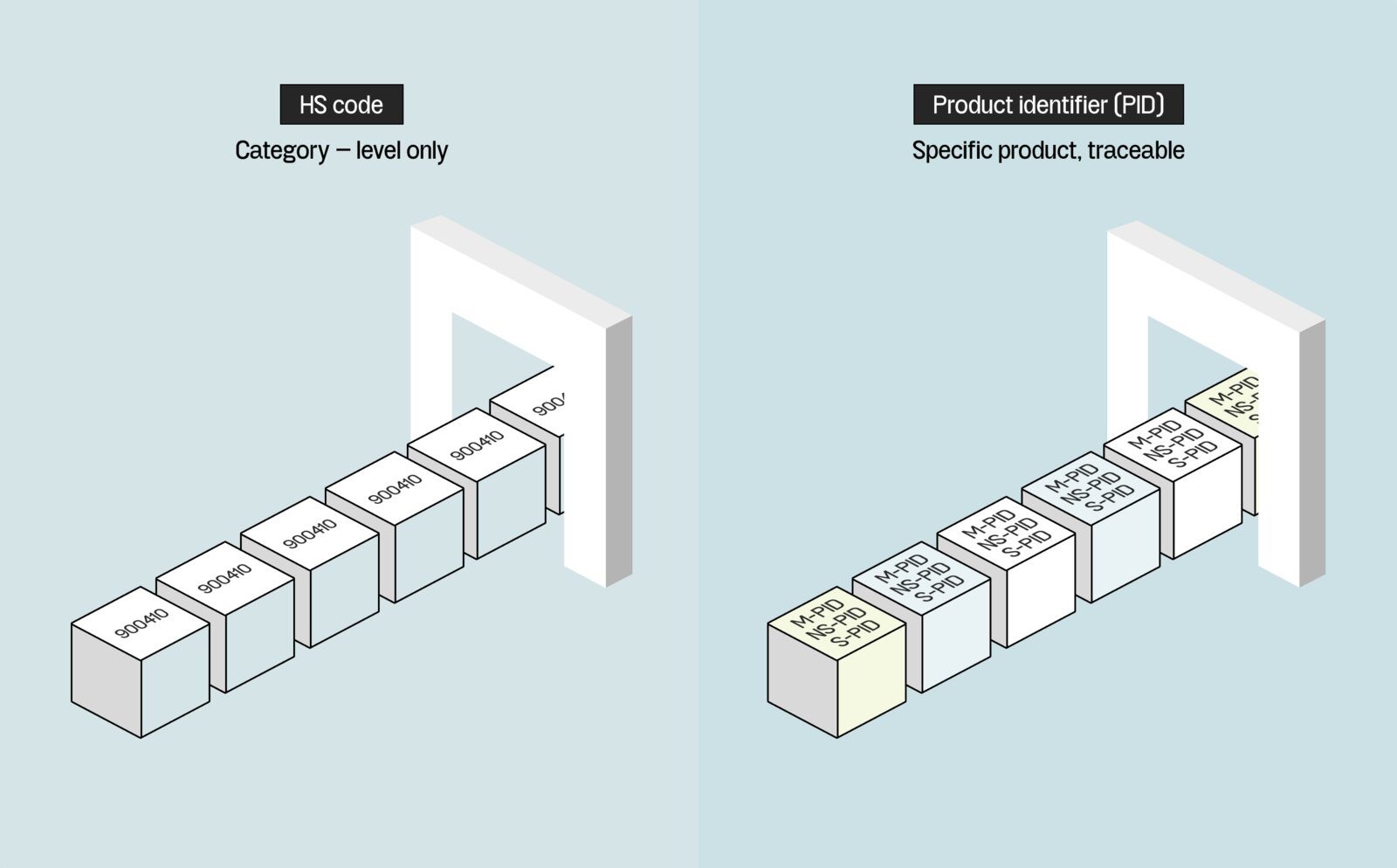
Today the customs declaration needs a description, a value, an origin, and an HS code: a number saying what category of thing it is. “Leather footwear.” “Digital cameras.” From 1 November the form also needs identifiers saying which specific product it is.
These are not new codes invented in Brussels. They already exist in commerce. A shop’s SKU. A manufacturer’s model number. The barcode on the box. What is new is that they now have to appear on the customs declaration, and someone is legally answerable for them.
The regulation defines a product identifier as a “unique alphanumeric code assigned to a specific model, batch or article, at any packaging level.”
2. Why the EU is asking for product identifiers
An HS code can tell customs that a parcel contains sunglasses. It cannot tell them these are the same sunglasses that failed a safety test last month.
A product identifier links one parcel to every other parcel containing that exact product. One inspection can then flag thousands of shipments. In the Commission’s own words, the objective is:
“to improve controls in distance sales of imported goods or, in other words, to deliver more effective risk management and enforcement of prohibitions and restrictions on goods in e-commerce.”
The driver is product safety, not revenue. A joint EU inspection operation in April to June 2025, targeting toys and small electronics bought direct from non-EU sellers, found that “more than half of the controlled products are not compliant with EU rules.” That was a deliberately targeted sample rather than a random one, but the direction of travel is clear enough.
3. M-PID, NS-PID and S-PID: the three codes explained
Every product is supposed to have up to three names, depending on who is doing the naming.
| Identifier | In plain terms | Required? |
|---|---|---|
| M-PID (merchant product identifier) | What the shop calls it. The SKU or listing number on the site the customer bought from. Assigned by the online seller, marketplace or platform. | Always |
| NS-PID (non-standardised manufacturer product identifier) | What the maker calls it. A model number or factory part code, in whatever format they use. Assigned by the manufacturer, producer or product supplier. | Always |
| S-PID (standardised manufacturer product identifier) | The barcode. A GTIN: the family covering EAN, UPC, ISBN and Japan’s JAN. | Only where one exists |
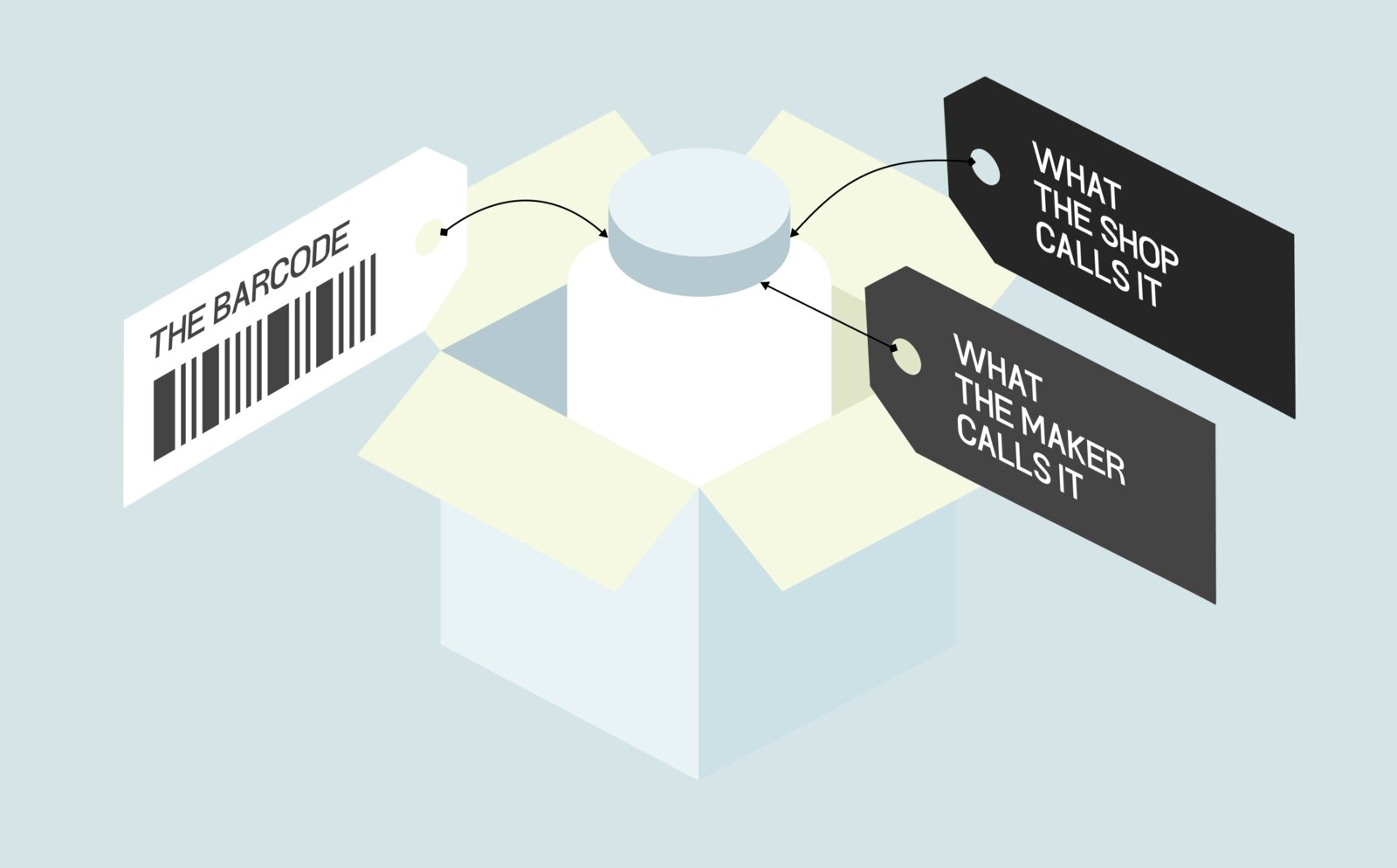
So: the shop’s name for it, the maker’s name for it, and the barcode. The whole rule follows from those three.
Two things that are easy to miss.
It is per distinct product, not per parcel. If one customs line covers several different products, each one needs its own set of identifiers. Goods can group onto a single customs line where the commodity code, description and origin all match, but that relief does not reach the identifiers. Eight different things in a consolidated box means eight sets of identifiers, whether they occupy one line or eight.
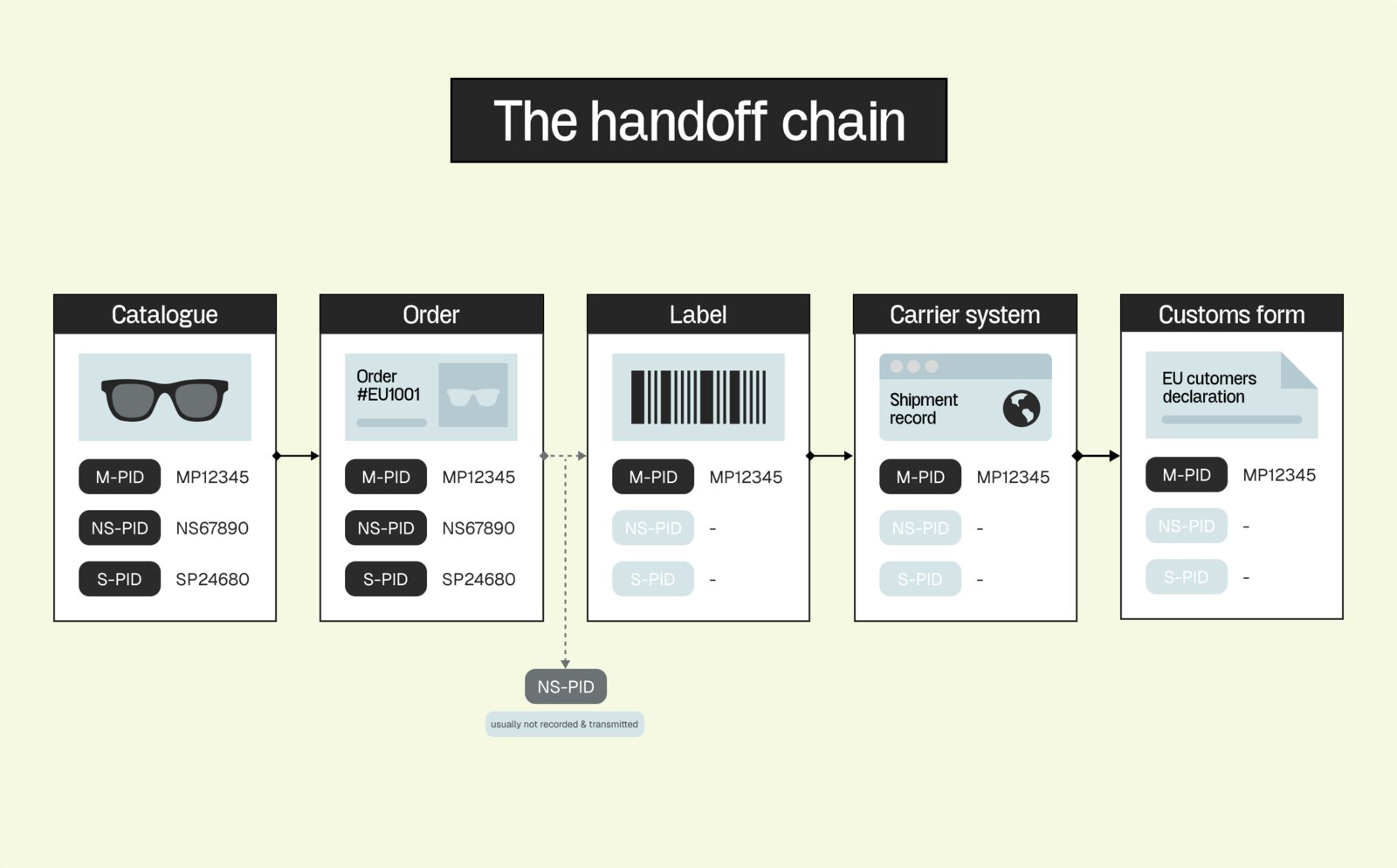
The obligation lands on the declarant, which is usually your carrier or customs broker. They answer to customs even though you hold the data, and nothing today obliges anyone to pass a manufacturer’s code down that chain. That split is the root of most of the trouble.
A worked example: the same product on two different shops
A Bosch cordless drill, model GSR 18V-55, listed by two unrelated online retailers. Bosch prints the model on the box and the barcode alongside it.
| Listing | M-PID (C127) | NS-PID (C128) | S-PID (C129) |
|---|---|---|---|
Retailer A, own SKU DRL-4471 | DRL-4471 | 06019H5202 | 4059952509303 |
Retailer B, own SKU TOOL-88213 | TOOL-88213 | Same: 06019H5202 | Same: 4059952509303 |
Two of the three codes belong to the product. Only one belongs to the shop. Each retailer’s SKU is its own, so the M-PID differs. The model designation and the barcode belong to the drill, so customs expects the same values from both sellers.
The failure to avoid is the opposite: inventing a different manufacturer code for each identical product. That is the behaviour the guidance calls an act contrary to the objective.
4. Product identifier vs HS code: what’s the difference?
They are different zoom levels on the same object, and both are now required.
| HS code | Product identifier (PID) | |
|---|---|---|
| What it names | The category of goods | The specific product |
| Example | 8467 21 (hand-held drills) | GSR18V-55 (one Bosch model) |
| Who assigns it | The World Customs Organization, extended by the EU to 10 digits | The shop, or the manufacturer |
| What it decides | The duty rate | Which shipments a safety flag catches |
| Required from | Already required | 1 November 2026 |
An HS code that is wrong changes what you pay. A product identifier that is wrong or missing changes whether your parcel moves. And the exemption routing in the rule keys off the HS code, so getting classification right is a prerequisite for getting identifiers right. If your HS codes are guesswork today, fix that first. Our customs primer covers how classification, customs value and import VAT fit together.
5. PID deadlines: 1 July, 31 October, 1 November 2026
The rule itself is Commission Delegated Regulation (EU) 2026/1022 of 30 June 2026, which defines the three identifiers and adds them to the customs form’s data requirements. It is published and in force.
| Date | What happens |
|---|---|
| 1 Jul 2026 | PIDs can be filed voluntarily. “No sanction, penalty or other measure may be taken because the data would not be provided or would be incorrect.” |
| 31 Oct 2026 | Last day of the free testing window. |
| 1 Nov 2026 | Mandatory. “Effective enforcement will start as from 1 November 2026.” The document codes stop being optional annotations and become enforced TARIC measures. A new EU-wide handling fee on small parcels also begins on this date, at a level still to be set by delegated act. |
| 1 Jul 2028 | The €3 interim duty ends. The EU Customs Data Hub opens for e-commerce, and more comprehensive product data requirements are expected with it. |
The window closes at the end of October. Until then you can file real identifiers against real parcels with a written guarantee of no penalty. That is a free test environment for your data, your carrier integration and your exception handling.
6. Five rules your product identifiers have to satisfy
This is where most preparation goes wrong. The fields are easy. The constraints on what you may put in them are not.
1. It has to stick. The guidance requires that “the identifier remains unchanged throughout the product’s lifecycle (at least from manufacturing to offer for sale to delivery).” A code invented fresh for each order is not a product identifier.
2. One code, one variant. “Each PID must refer to exactly one product variant (same brand, size, color, packaging, etc.).” Size and colour level, not product-family level.
3. Do not go finer than the maker did. Reporting identifiers “at batch or unit level where one exists at model level” is named explicitly as an infringement. If the manufacturer has a model code, use it. Minting your own per-item code instead is a breach, and it is the failure mode the guidance singles out for bad faith.
4. Everything is assumed to have a manufacturer code. “The new requirement assumes that all products are assigned a NS-PID.” Where none exists, the “manufacturer, producer or product supplier is expected to assign one.” We don’t have it is not an answer the form accepts.
5. The barcode can do double duty. This is the single most useful line in the whole guidance. A supplier “may decide to assign no NS-PID but use the S-PID also as NS-PID to simplify their operations; this is perfectly acceptable.”
Read rule 5 again, because it is the cheapest win available. Wherever a barcode exists, file it as both the S-PID and the NS-PID. Expressly permitted, costs nothing, and for a conventional branded catalogue it removes the largest slice of the problem in one move.
Where no barcode exists, you file Y081 to declare that. Staying silent is not an option, and over-use is visible: every Y081 is a recorded assertion that no barcode exists for that product. A seller filing it across an obviously barcoded catalogue is easy to find.
7. Who is covered, and does PID apply above €150?
| What kind of sale | Any sale where a business ships goods from outside the EU to a consumer inside it: a “distance sale of imported goods”. |
| Where the seller is | Irrelevant. Japan, US, UK, anywhere. |
| Which channel | All of them, post included. |
| Order value | No cap in the law. See below. |
| B2B | Not a distance sale to a consumer, so outside the rule. |
| Not covered | Genuine person-to-person parcels and gifts. There is no business seller, so it is not a “sale”. Note that this follows from the definition; the guidance never writes down a gift exemption. |
On order value, the law and the enforcement do not line up, and this is worth getting right.
The law contains no €150 limit. It triggers on the type of sale, not the amount: identifiers “shall be provided for each item regarding goods sold in distance sales of imported goods.”
The automated checking, though, may only reach €150. The guidance hooks validation to three procedure codes (F48 IOSS, F49 special arrangement, F53 standard VAT), and national customs guidance says all three are only usable for parcels up to €150 sold to private individuals. At least one major carrier has already picked a side: FedEx’s Ship API scopes the PID fields to EU27 shipments under €150.
Our reading: the obligation applies at any value, even if the automated check probably doesn’t. Do not build on the assumption that goods above €150 are exempt, and be careful with any guide that tells you they are.
8. PID exemptions, and the goods explicitly denied one
Some goods are “deemed administratively to comply” if you file the literal placeholder text M-PID and NS-PID instead of real values.
| Exempt category | HS scope |
|---|---|
| Unprocessed agricultural and perishable goods | Chapters 1 to 15 |
| Hand-made and artisanal goods | 4420 11, 4420 19, 4602, 4802 10 00, 5702 10 00, 5804 30 00, 5805 00 00, and a set of 7013 glassware codes |
| Antiques, collectibles, art, stamps and coins | 9701 to 9706 |
The code list is captioned “(non-exhaustive list)”, which is a hook for arguing a code in. It is not proof that anything absent is excluded.
Then there is the other half, and it is the part most guides skip:
“Other cases do not benefit from privileged administrative treatment. For example, second-hand and refurbished goods as well as custom, personalised and print-on-demand goods shall comply with the new PID requirement.”
| Case | What to file instead | Wording |
|---|---|---|
| Second-hand and refurbished goods | “The PID of the original product shall be provided in case of second-hand good.” | shall |
| Personalised textiles | “The PID of the underlying textile should be provided” | should |
| Customised and print-on-demand offers | “The PID of an underlying good or service shall be provided in the customised offer for sale.” | shall |
Notice the line this draws. A genuine antique gets a placeholder and walks through. A three-year-old pair of trainers does not, and must be declared with the original maker’s code, which may belong to a company that no longer exists. The concession was written for goods that never had identifiers. It was not written for goods whose identifiers have been lost, and resale lives almost entirely in that second category.
If you sell refurbished, second-hand, vintage, personalised or made-to-order goods, this is the paragraph to read twice.
9. What is still genuinely unsettled
Several guides published this summer describe a clean rejection workflow: miss a PID, parcel held, declaration rejected. That detail is not in the guidance. We looked.
The guidance sets out no process for rejection, appeals or corrections. The only hint anywhere is a remark in the medical-goods section about avoiding a situation where “a declaration is held or rejected for noncompliance with the PID requirement.” Anyone describing a defined rejection workflow is filling in a blank.
There is also a live conflict between two official bodies, and it is worth knowing about even though it should not change your plan.
- They agree on two of the three codes. The M-PID is unconditional. The S-PID is required only where one exists, with
Y081otherwise. No dispute. - They disagree on the NS-PID. The Commission says it is required “in all cases, with no exception.” The Universal Postal Union tells postal operators the opposite: the M-PID is mandatory “whereas the standardized manufacturer product identifier (S-PID) and NS-PID are conditional.” The UPU also tells posts that “missing PID information will not automatically lead to rejection of the declaration”, a soft landing the Commission guidance never mentions.
Plan for the Commission’s reading. The legal text supports it: the delegated regulation’s annex qualifies only the S-PID with “if it exists” and attaches no such condition to the NS-PID. The UPU material is guidance to postal operators, not EU law. The conflict is a reason to watch for further guidance closer to November, not a reason to prepare for a lighter requirement, and it happens to land on precisely the field that is hardest to fill.
10. Four things to do before 31 October
In the order that gets you the most coverage for the least work.
1. Use the barcode twice. Wherever a GTIN exists, file it as both the S-PID and the NS-PID. Expressly permitted, free, and it closes the largest slice of a conventional catalogue immediately.
2. Build a product record, not an order field. One record per product variant holding all three values, plus where each value came from and when it was last checked. It has to be stable and reusable across orders, or it fails rule 1.
3. Route the exceptions off the HS code. Agricultural, artisanal and antique codes get placeholders. Healthcare goods get the narrower barcode concession. Everything else needs real values. This depends entirely on your HS classification being right first, which is its own piece of work.
4. Get the values onto the label. The data has to reach your carrier’s system, in the right fields, per item. Fields and formats differ between carriers, so ask your carrier and your broker directly which fields they accept today and what they do with a Y081. Then test it against real parcels while the no-penalty window is open.
11. Where this sits next to your tax and your payments
Worth being direct about something, because it cuts against our own interest.
Product identifiers sit on the customs declaration, in the supporting-document field, next to the HS code. They are not a VAT field and they are not filed with a tax return. That matters mostly when you are working out who to ask: whoever handles your VAT registrations and filings is not, by virtue of that, handling this. Ask the question explicitly rather than assuming it is covered.
What the November change does is add a third thing a cross-border seller has to own, alongside the two they already had.
- The money. Taking a payment from an EU consumer on a non-local entity costs you approval rate and margin. A local seller, taking payment locally, wins both back.
- The tax. VAT registration, filing, remittance, and the legal answerability that comes with them.
- The customs data. Classification, landed cost, and now product identifiers, filed accurately per item, and accepted by your carrier.
At Outpost we become the legal seller in each market so the money stays local, we become liable for the VAT and sales tax so a filing error is our problem rather than yours, and we handle the customs requirements and duty side at the border. If we get a filing wrong, we pay the fine.
12. Product identifier FAQ
What is an EU product identifier (PID)?
A code declared on the customs form that names the exact product inside a parcel, rather than its category. From 1 November 2026, B2C parcels entering the EU must declare one or more for every item.
What is the difference between M-PID, NS-PID and S-PID?
The M-PID is what the shop calls the product, usually its SKU or listing number, filed under document code C127. The NS-PID is what the manufacturer calls it, a model or part number, filed under C128. The S-PID is the barcode, a GTIN such as an EAN, UPC, ISBN or JAN, filed under C129.
Is the NS-PID mandatory?
Under Commission guidance, yes, “in all cases, with no exception”. The Universal Postal Union tells postal operators it is conditional, which conflicts with the Commission. The legal text supports the Commission, so plan on the NS-PID being required.
What do I file if a product has no barcode?
Document code Y081, which declares that no standardised identifier exists. Leaving the field empty is not an option. Do not over-use it: every Y081 is a recorded assertion, and a seller filing it across an obviously barcoded catalogue is easy to spot.
Can I use the barcode as both the S-PID and the NS-PID?
Yes. The guidance says a supplier “may decide to assign no NS-PID but use the S-PID also as NS-PID to simplify their operations; this is perfectly acceptable.” It is the cheapest compliance win available.
Do product identifiers apply to orders above €150?
The law contains no value limit, so the obligation applies at any value. The automated validation may only reach €150, because it is hooked to procedure codes usable only up to that threshold. Do not assume goods above €150 are exempt.
Do product identifiers apply to second-hand goods?
Yes, and second-hand and refurbished goods are named explicitly as not benefiting from the exemptions. “The PID of the original product shall be provided in case of second-hand good.” Custom, personalised and print-on-demand goods are also named.
Which goods are exempt from the PID requirement?
Unprocessed agricultural and perishable goods (HS chapters 1 to 15), listed hand-made and artisanal goods, and antiques, collectibles, art, stamps and coins (HS 9701 to 9706) may file the placeholder text M-PID and NS-PID. Healthcare goods get a narrower concession covering only the barcode field.
Do PIDs apply to B2B shipments?
No. The rule triggers on a “distance sale of imported goods”, meaning a business selling to a consumer in the EU. Genuine person-to-person parcels and gifts are also outside it, though the guidance never writes down a gift exemption.
What happens if a product identifier is missing after 1 November?
The guidance sets out no rejection or appeals process, so any source describing a defined rejection workflow is filling in a blank. What the guidance does say is that deliberately filing identifiers that defeat the purpose of the rule “will, as a rule, be considered as an act contrary to the objective”.
Which customs declarations need product identifiers?
H7 (parcels up to €150), H6 (postal) and H1 (standard, used above €150). The values go in the “Supporting document” field, 12 03 000 000, with the code in 12 03 002 000 and the identifier in 12 03 001 000.
When can I start testing?
Now. PIDs have been filable voluntarily since 1 July 2026, with a written guarantee that “no sanction, penalty or other measure may be taken because the data would not be provided or would be incorrect”. That window closes on 31 October 2026.
Want to talk through what the 1 November change means for your catalogue and your carrier setup? Request a demo.
Continue reading
- Customs 101: what the end of EU de minimis means for cross-border sellers - Will Mahon-Heap & Ludmila Ondarcuhu, 8 June 2026.

