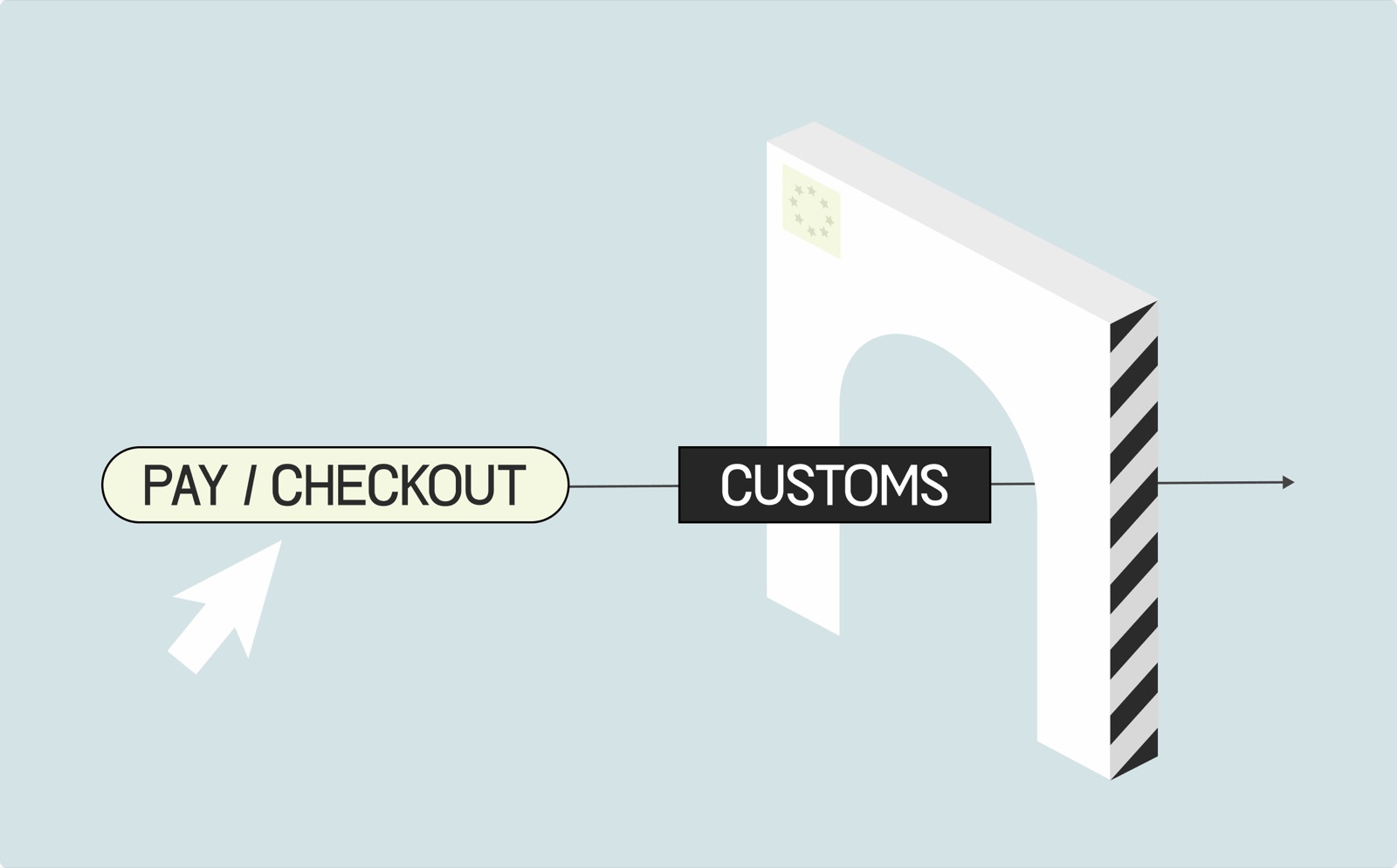
Working out the tax is the easy part. The rest of the job is the question: who classifies the goods, who registers, who files, who signs for the parcel at the border, and what the buyer actually sees at checkout.
Every cross-border checkout has to do two things in the same second.
It has to take the money in a way the buyer’s own bank will approve. And it has to show a price that’s already final, with import duty and VAT inside it, so a courier doesn’t turn up two weeks later asking for another €40 before handing over the box.
Most sellers cover the second half with a duty and tax calculator. You send it a product and a destination, and it sends back a percentage.
That percentage is the cheap part. Classifying every product, registering in each market, filing, paying, standing at the border as the legal importer, and answering the tax office when a number is wrong: that’s the job. It usually lands on a finance team that never agreed to run a customs department.
Below is the full breakdown. What it costs in practice, and what changed when the EU removed its €150 duty exemption.
In short: A duty and tax calculator gives you a rate. You still classify the goods, register in each market, file, pay, act as importer of record at the border, and carry the exposure if the number is wrong. We do all of that in our name, and take the payment locally so more of it goes through. One API call returns the landed price, line by line, ready to show at checkout.
Scope: this post is about physical goods crossing a border. Customs duty applies to parcels and never to a digital download. VAT applies to both, so a seller of digital products can skip the duty sections and the rest still holds.
Table of contents
- The two jobs at a cross-border checkout
- What a calculator does, and what it leaves on your desk
- Why the two fees aren’t comparable line for line
- What a landed price actually looks like
- What changed on 1 July, and what changes again in 2028
- Six questions to ask any provider before you sign
- FAQ
The two jobs at a cross-border checkout
Start with payments, because that’s the job that makes money.
A shopper in Germany buys from a seller in Japan. Her card details go to her own bank for approval, and her bank can see that the money is heading to a foreign business. Foreign businesses get declined more often than local ones, on identical orders. Smarter retry rules won’t move that. The bank is deciding based on who is asking for the money, and that answer only changes when the company asking is local.
Local means a real company registered in that market, taking the payment as the seller. It has its own merchant ID, which is the account a bank sees the sale arriving from. It has its own merchant category code, the four-digit number card networks use to say what kind of business you are. Ours is never pooled into one shared code alongside thousands of unrelated sellers, which is how most providers are built.
The gap is 25 to 40% more approvals than cross-border processing, and roughly 7% more per market on average. Same traffic, same product, more orders that go through.
Then the second job, one click later: the price has to be true. Duty and import VAT have to be calculated and shown before the buyer commits. Otherwise the parcel arrives with a charge attached, the buyer refuses it, and you’re paying for a refund, a return leg and a customer who doesn’t come back.
Both jobs happen at the same checkout. Sellers usually solve them with two unrelated purchases, and the tax half is the one that keeps sending work back.
What a calculator does, and what it leaves on your desk
Here’s the honest split. The left column is what duty and tax calculation software (Vertex, Avalara, EAS and the rest of that category) does for you. The right column is what happens when someone becomes the party of record instead.
| Responsibility | Duty and tax calculation software | Outpost |
|---|---|---|
| VAT | ||
| Classify each product to a VAT rate, per country | You | Us |
| Calculate VAT at checkout | The software | Us |
| Register for VAT and IOSS in each market | You, or an agent in your name | Us, in our name |
| File and pay the VAT | You, or an agent in your name | Us, in our name |
| Duties | ||
| Classify to tariff sub-heading and determine origin | You | Us |
| Calculate duty, including the €3 flat charge per category on sub-€150 parcels | You | Us |
| Apply the right treatment either side of €150, and track it as the rules change again in 2028 | You | Us |
| Act as declarant and importer of record at the border | You | Us |
| Pay the duty to customs | You | Us |
| Both | ||
| Handle audits, queries and correspondence | You | Us |
| Answer for it if the classification is wrong | You | Us |
Two rows in that table carry more weight than the others.
“In our name.” We’re already registered, so you never have to be. Years of advice and meetings with authorities around the world sit behind those registrations, and they belong to us. You never register, never file, and never speak to a European tax office. When a carrier asks for an IOSS number, the EU registration that allows import VAT to be collected at checkout instead of at the door, you give them ours. We become the importer of record, the company legally responsible for the goods entering the country, and the authorities deal with us.
“Answer for it if the classification is wrong.” If we put a product in the wrong tariff code, the exposure is ours. A tool hands you a number and a disclaimer, and the fine still arrives at your address.
Why the two fees aren’t comparable line for line
This comes up in every commercial conversation, and it’s a fair challenge: our fee looks higher than the calculator quote.
The two fees buy different things. A calculator fee replaces a calculator. An of-record fee replaces that calculator plus classification, registrations, fiscal representation, filings, payments, duty at the border, audit correspondence, and the internal hours it takes to run all of it. Most finance teams never put a price on that last item, because it’s already sunk in somebody’s week.
We ran a procurement round across these providers two years ago, so we know their wholesale rates. On total cost, you need very high product volumes before the calculator model wins. At those volumes you’re still doing the classification work yourself, and still carrying the exposure when it’s wrong.
Compare the whole list.
What a landed price actually looks like
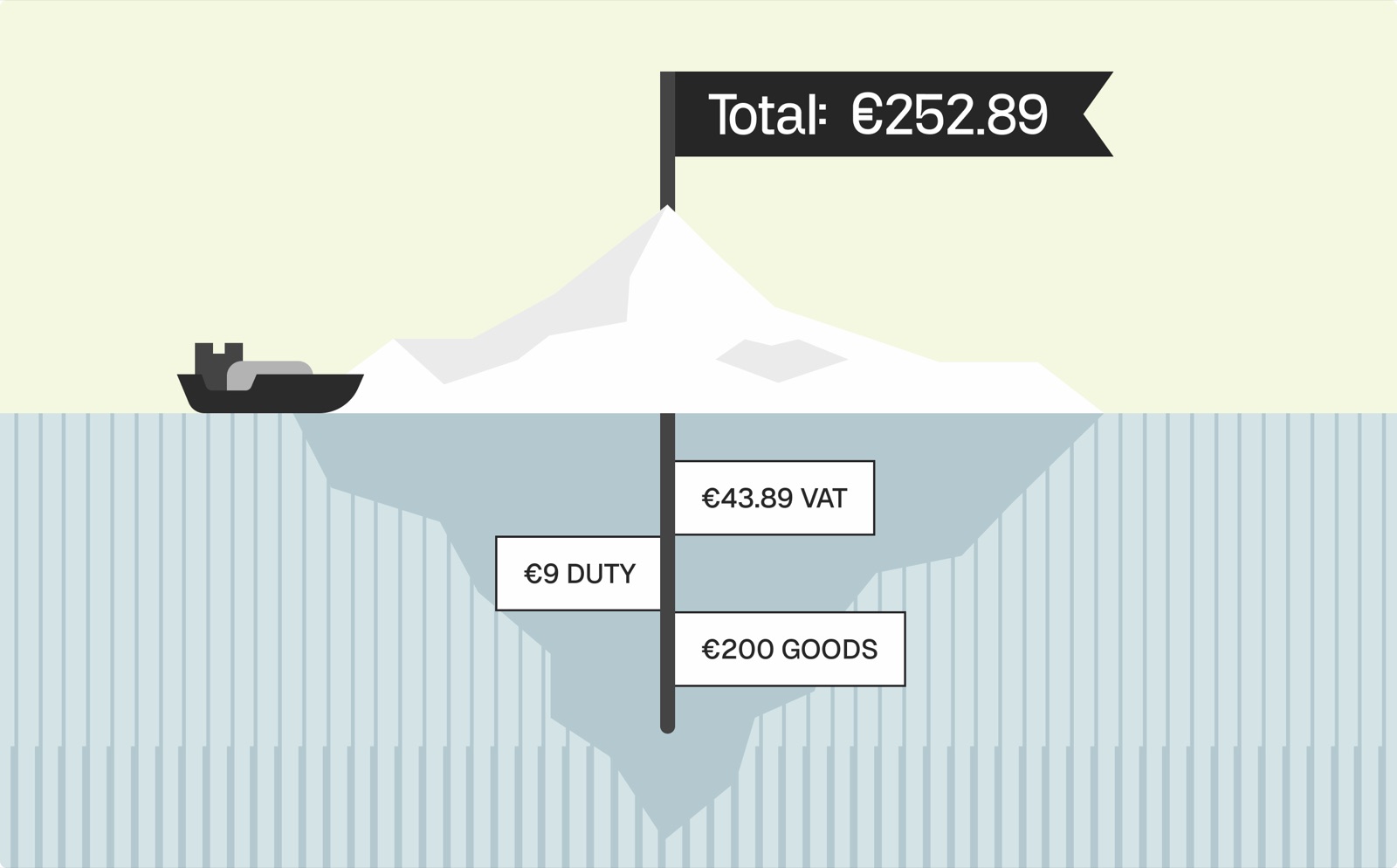
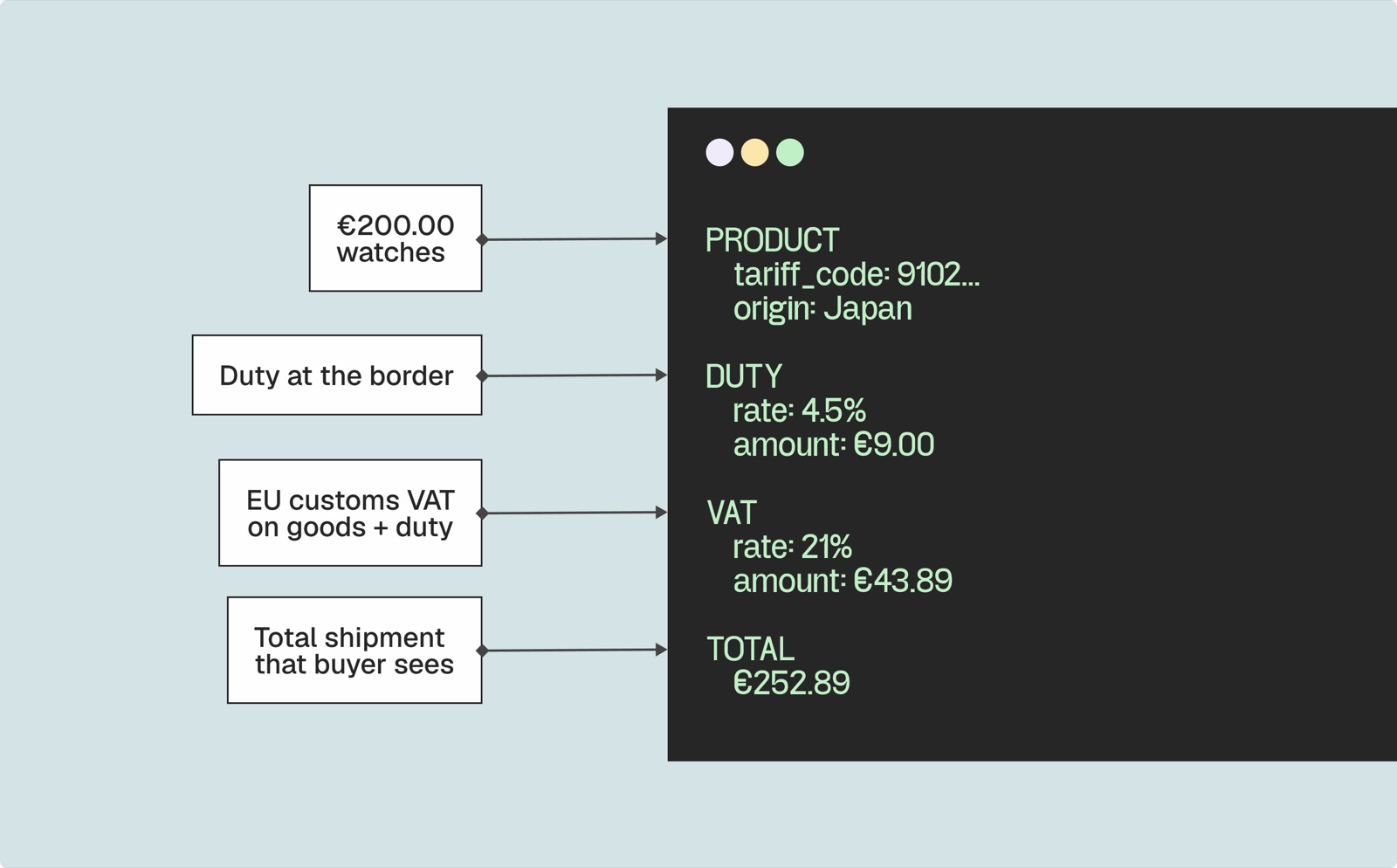
Take a €200 watch shipped from Japan to a customer in the Netherlands.
- Duty: €9.00, at 4.5%
- Import VAT: €43.89, at 21%, charged on the goods plus the duty, which is how EU customs assesses import VAT
- Total to show the buyer: €252.89
The order of operations matters. VAT sits on top of the goods and the duty, so a checkout that adds the two side by side under-collects on every single order.
In the EU, duty is charged on the CIF value: goods, insurance and freight together. That means shipping has to be split across the items in a consolidated parcel before duty can be priced at all. It’s the calculation a spreadsheet gets wrong the moment six items travel in one box.
One call returns all of it. You send the cart contents and the destination. The response comes back per line item: duty rate and amount, VAT rate and amount, and any other charge as its own labelled component, with shipment-level totals alongside, so the figures at checkout reconcile line by line.
There are two ways to send it, and you can mix them inside one cart:
- You know the code. Send the tariff code and the country of manufacture on the line, and we price the duty straight from your code.
- You don’t know the code. Send the product description, the category, the country of manufacture and the unit price, and classification runs on that product data first.
Country of manufacture isn’t a formality. It decides whether preferential rates under trade agreements apply, such as the EU-Japan agreement, and it means where the goods were made rather than where they shipped from.
There’s no separate customs integration to build. Duty comes back through the same call as the tax. Customs clearance and the import declarations are handled by us as the importer of record, and the parcel arrives delivered duty paid: everything settled up front, nothing owed at the door. Most merchants are integrated in about two days of engineering. Going live after that takes hours.
What changed on 1 July, and what changes again in 2028
The EU removed the €150 duty exemption on 1 July 2026. Every parcel entering the EU now needs a formal customs entry, and an interim flat €3 duty applies to low-value consignments while the permanent regime is built. That €3 is charged per product category, so a consolidated box of six items spanning four categories is charged four times. A separate EU handling fee of around €2 is expected later this year, and France has been running its own €2-per-item version since 1 March 2026.
Two practical consequences for anyone shipping small parcels into Europe.
- The €150 line still matters, in the other direction. Below it, you’re in the interim flat-duty regime. Above it, you’re in full classification, and delivered duty paid if you want the buyer to see a final price. Both sides have to be priced correctly, and plenty of sellers only ever built for one.
- More is coming. The EU Customs Data Hub replaces the interim regime with full tariff assessment from 2028. Whatever a team maps this quarter gets remapped then. Someone has to own that work and keep owning it, which is a hire, and most teams never get round to making it.
Six questions to ask any provider before you sign
- Whose name is on the VAT and IOSS registration, mine or yours?
- Who files and pays, and who receives the letters from the tax office?
- Who is the declarant and importer of record at the border?
- If a classification is wrong, whose exposure is it?
- Does duty come back in the same call as tax, or is that a second integration?
- What happens to my pricing when the interim regime is replaced in 2028, and who does that work?
If the answer to most of those is “you”, what you’re buying is a number.
What’s next
1 July moved work as well as cost, and the work lands on whoever is the importer of record when the parcel arrives. Sellers who priced the landed cost honestly at checkout kept their conversion. Sellers who bought a calculator inherited a compliance department.
Done properly, this earns its place. Selling as a local company makes more money on the same traffic. One price covers the calculator, the registrations, the fiscal representative and the internal time. The filings and the border paperwork stop being yours. And if we get a classification wrong, we pay the fine.
Want to see a landed price come back from a single call, on your own catalogue? Request a demo.
FAQ
Is this the same as tax calculation software?
No. Calculation software returns a rate. We’re the party the tax authority invoices and writes to, using our registrations, and the exposure for a wrong classification is ours.
Do I have to give you tariff codes?
No. Send the product description and we’ll classify it. If you already hold good codes, send them and we price duty directly from them. You can mix both in one cart.
Can I keep my current payment stack?
Yes. We work alongside your existing providers, and we can also take the payment as the local seller in market, which is where the approval-rate gain comes from.
What about parcels above €150?
Both sides of the threshold are covered. Above €150 the goods go through full classification and can be delivered duty paid, so the buyer still sees one final price.
How long does integration take?
About two days of engineering for most merchants. One endpoint returns tax and duty together, so there’s no separate customs build. Going live after that takes hours.

